Blog
Articles on commodity price risk, and related topics for the strategic purchaser, from the team building MetalAlert.
 Copper procurement
How to calculate your copper exposure from the bill of materials and annual volumes
Step-by-step method to calculate copper exposure from your BOM: copper per SKU, alloys, cables, scrap credits, pricing basis, timing and $1,000/t sensitivity.
 Copper procurement
How to build a copper budget with best, base and worst-case price scenarios
How to set best, base and worst-case copper prices for a budget using the forward curve and volatility, weight the scenarios, and include hedges and FX.
 Copper procurement
What Is the Copper Price Forecast for the Next 6-12 Months?
Copper price forecast 2027 as of November 2026: bank and ICSG views, the drivers behind them, how accurate forecasts are and how buyers should use them.
 Copper procurement
How Can a Mid-Sized Manufacturer Hedge Copper Price Risk Without a Trading Desk?
How to hedge copper price risk without a trading desk: supplier fixed prices, price-fix windows, bank swaps, LME brokers and options, ranked by complexity.
 Copper procurement
Copper market weekly update for procurement teams (template + week 44, 2026 example)
A reusable weekly copper market update template for procurement teams, with a worked example for week 44 of 2026: prices, stocks, premiums, Fed and tariffs.
 Copper procurement
Should I Lock In Copper Prices Now for 2027, or Buy at Spot?
Lock in copper prices for 2027 or buy at spot? A decision framework for buyers: forecast spread, forward curve, cost of fixing, move probabilities and layering.
 Copper procurement
How will US copper tariffs affect European copper prices?
How US Section 232 copper tariffs reach European buyers through the LME price, physical premiums and semis trade, with 2027 scenarios and what to watch.
 Insight
Who Is Best at Forecasting Copper Prices?
The EIU won the 2026 copper forecasting awards, but rankings rotate and long-range forecasts are the least reliable. Why a metal buyer should watch for rising risk instead of trusting one number.
 Insight
Forecast vs. Probability of Price Change: A Better Way to Make Commodity Buying Decisions
Why knowing the likelihood of a price movement can be more valuable than knowing where someone thinks the market is heading.
 Insight
Why nobody can forecast the exact steel price, and what to track instead
Point forecasts for steel and other metals fail for structural reasons. Here's why, and what a calibrated probability gives you instead.
 Guide
Aluminium (aluminum) premium explained: Midwest, Rotterdam and Japan
The LME price is only part of what an aluminium buyer pays. The rest is a regional premium that moves on its own: what it is, how the main ones differ and how to budget it.
 Guide
Copper cathode premium explained: what it is, who sets it and how to budget for it
Buyers rarely pay the bare LME copper price. The cathode premium, and often a rod or wire premium on top, is part of the cost: what they are, who sets them and how to budget.
 Guide
LME vs COMEX copper: why the prices differ and what the spread means for buyers
Two benchmarks for one metal: how to put LME and COMEX copper in the same unit, what drives the gap between them and which one a buyer's contract should follow.
 Guide
What is purchase price variance (PPV)? Formula, example and how to reduce it
The PPV formula, a worked copper example, favorable vs unfavorable, what causes the variance and how to manage it when the material is priced off a metal market.
 Comparison
CTRM software vs. a probability alert: what a mid-size procurement team actually needs
CTRM platforms are built for trading desks running a multi-commodity book. Most metal-buying procurement teams need one specific trigger, not a trading system.
 Guide
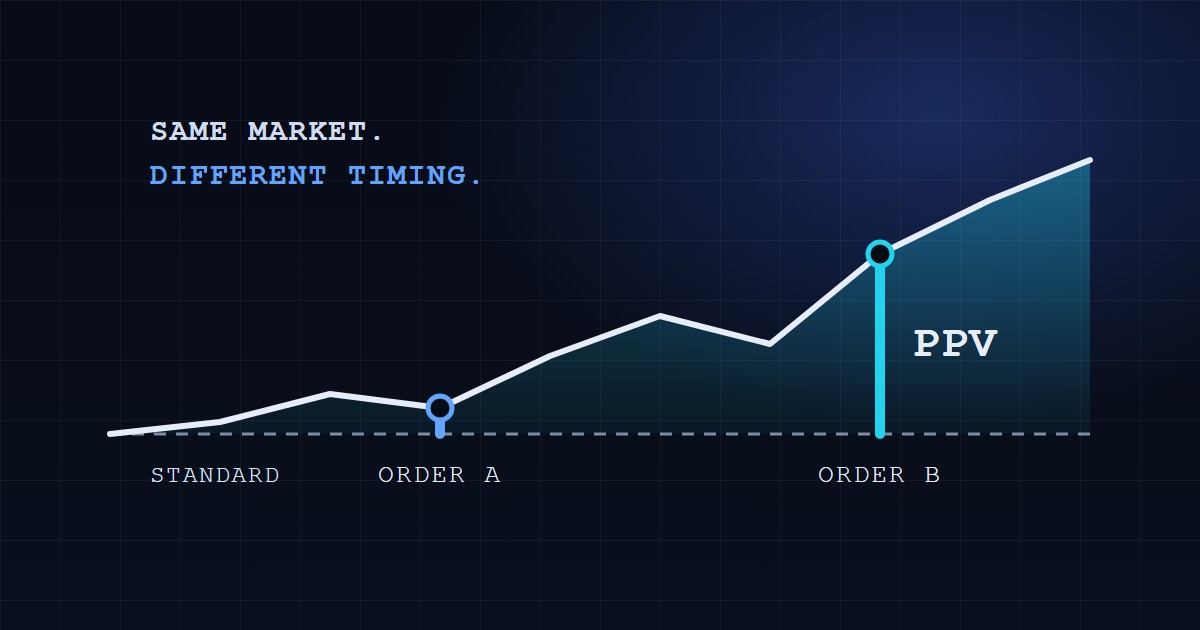
Purchase price variance on metals: why “the market moved” isn't the whole story
Part of an unfavorable PPV usually gets written off as the market moving against you. Some of it is really about when the order was placed, a decision you do control.
 Case study
How a Steel Wholesaler's Predictive Model Paid Back 13% of Its Cost
A results-first look at Andrea Krogdal's GAIA talk: the proof-of-concept results, the checkpoints that proved the model held up on live data, and the single decision that paid back 13% of the project cost.
 Guide
Order timing for metal buyers: why it matters and what works
Why order timing drives so much of landed cost, what forward buying, hedging, index-linked contracts and staggered purchasing actually do, and where a calibrated probability fits into a decision that's usually made on a hunch.
 Insight
Stop asking for the price forecast. Ask for the price probability.
A point forecast gives one number that is almost always wrong. A probability forecast tells you how likely a move is and how big. The pros and cons of each, and when to use which.